How do emperor penguins survive the winter?
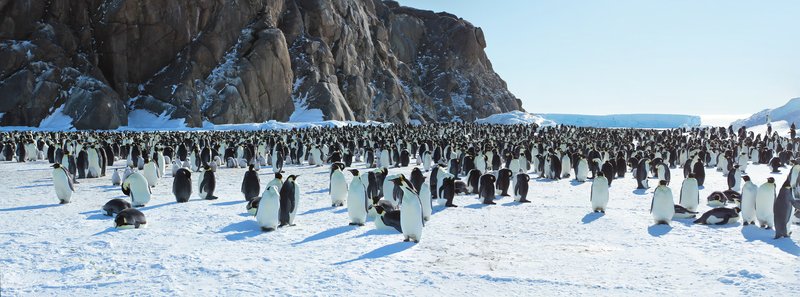
Image information and credit
A panoramic view of a penguin colony on sea ice, named in the purchased file’s embedded title as emperor penguins (Aptenodytes forsteri) on the sea ice of the Davis Sea, Eastern Antarctica. That geography is taken from the title and is not independently verified. This is not used as a general East Antarctica place photograph. Credit as embedded in the purchased file: Sergey - stock.adobe.com. Adobe Stock 189352629. Rights: owner-attested purchased; licence type (Standard or Extended) unknown. Official Adobe Stock listing not live-verified (lookup blocked with HTTP 403 on 24 Nov 2026 and not retried). Identification is based on the file’s embedded metadata and a local visual review, not an official live listing.
Emperor penguins combine insulation, energy reserves, heat conservation and cooperative huddling to survive their Antarctic winter breeding season.
Several adaptations work together
Emperor penguins do not survive winter through one remarkable trick. Their bodies and behaviour work together to reduce heat loss and make stored energy last. They breed during the Antarctic winter, so retaining warmth is especially important during the part of the annual cycle when breeding birds are on the ice.
Insulation and body shape
The Australian Antarctic Program describes several layers of closely packed, scale-like feathers. These form an insulating covering rather than an ordinary loose coat. Relative to their overall size, emperors have small bills and flippers, limiting the exposed structures through which heat can be lost. Their nasal chambers also recover some of the heat that would otherwise leave with exhaled air.
Conserving heat in the extremities
Blood vessels help to manage heat exchange. Arteries and veins lie close together, so blood heading toward the feet, wings and bill is cooled before reaching those areas, while returning blood is warmed on its way back toward the body. This should not be confused with a bird being equally warm everywhere: conserving a warm core can involve maintaining cooler extremities.
Why huddling matters
Emperors also change their exposure to wind and cold through huddling. Birds on an exposed edge do not necessarily remain there indefinitely. The Australian Antarctic Program describes a circulating group in which individuals move through warmer and colder positions. The huddle is therefore a changing arrangement, not a permanently privileged warm centre surrounded by the same birds.
Energy reserves and parental work
Body fat provides stored energy, and a relatively low level of winter activity helps conserve it. Males take on incubation; after hatching, the parents share the work of caring for chicks. These adaptations do not make the birds independent of their environment. Their breeding cycle, access to food and suitable colony conditions still matter.
To learn how these features fit into the whole species, continue to the emperor penguin profile. Photographs on this site are illustrations of the subject, not measurements of a colony’s present weather or population condition.
Sources and factual review
- Emperor penguin — Australian Antarctic Program; checked 2026-11-24.
Published: 2026-11-24T06:43:52.850982+00:00 · Substantive update: 2026-11-24T06:43:52.850982+00:00 · Factual review: 2026-11-24T06:43:52.850982+00:00