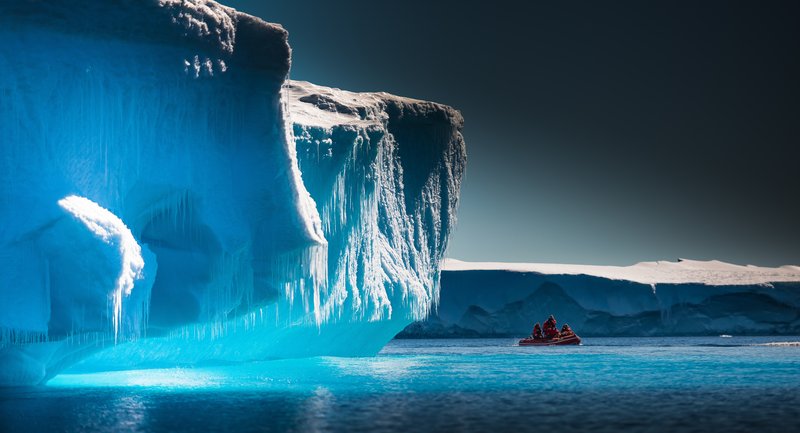
How Antarctic knowledge is made
Antarctic science joins field measurements with laboratory analysis, data management and international cooperation. Different research methods answer different questions. An ice core, an animal survey and a meteorite collection cannot be treated as equivalent kinds of evidence. These introductions explain what researchers actually examine and why dates, locations, methods and uncertainty belong alongside a finding.
Antarctic research spans ice, atmosphere, oceans, wildlife, geology and the wider Earth system. The continent is not a laboratory for only one subject, and research also depends on engineering, transport and international cooperation.
Scientists read an ice core by measuring evidence preserved in successive layers of snow and ice, then building an age model and interpreting several kinds of signal together. It is not simply a thermometer frozen into a tube.
Antarctica provides valuable places to search for meteorites because ice can preserve and expose material, and dark stones can be easier to recognise against an ice surface. Finding them still requires systematic fieldwork, not an assumption that every isolated rock came from space.
Antarctica became a major centre for international science through sustained field programmes, cooperation and a legal framework that protects peaceful scientific investigation. The International Geophysical Year of 1957–58 was an important catalyst, not the beginning of all Antarctic research.
Scientists read an ice core by measuring evidence preserved in successive layers of snow and ice, then building an age model and interpreting several kinds of signal together. It is not simply a thermometer frozen into a tube.
Antarctic science joins field measurements with laboratory analysis, data management and international cooperation. Different research methods answer different questions. An ice core, an animal survey and a meteorite collection cannot be treated as equivalent kinds of evidence. These introductions explain what researchers actually examine and why dates, locations, methods and uncertainty belong alongside a finding.
Antarctic research spans ice, atmosphere, oceans, wildlife, geology and the wider Earth system. The continent is not a laboratory for only one subject, and research also depends on engineering, transport and international cooperation.
Antarctica provides valuable places to search for meteorites because ice can preserve and expose material, and dark stones can be easier to recognise against an ice surface. Finding them still requires systematic fieldwork, not an assumption that every isolated rock came from space.
Published: 2026-11-24T07:58:29+00:00 · Substantive update: 2026-11-24T07:58:29+00:00 · Factual review: 2026-11-24T07:58:29+00:00