Why is Antarctica so cold?
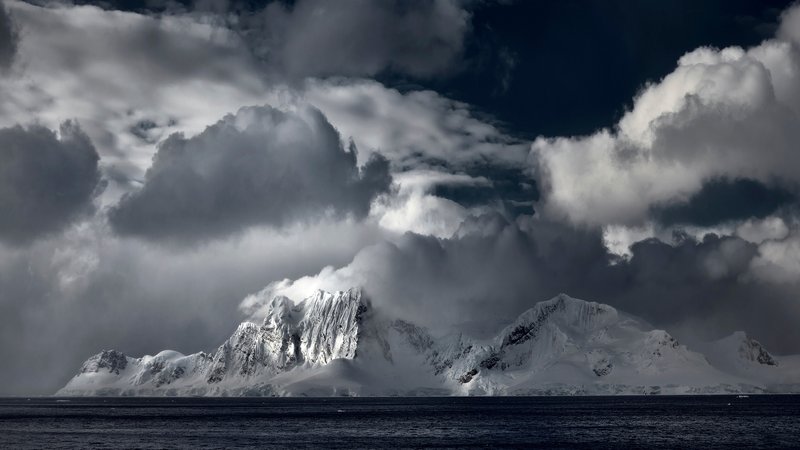
Image information and credit
Snowy mountains under a dark sky, with sunlight on the peaks. The embedded title describes a dramatic Antarctica landscape; exact location is not confirmed. The image is a general illustration of harsh Antarctic weather and is not a measured climate record. Credit as embedded in the purchased file: Mohamed - stock.adobe.com. Adobe Stock 2056874261. Rights: owner-attested purchased; licence type (Standard or Extended) unknown. Official Adobe Stock listing not live-verified (lookup blocked with HTTP 403 on 24 Nov 2026 and not retried). Identification is based on the file’s embedded metadata and a local visual review, not an official live listing.
Antarctica's cold reflects its polar setting, long winter darkness, extensive reflective ice and the elevation of much of the ice sheet. Conditions differ greatly between a coastal station and the high interior, so there is no single temperature for the continent.
Sunlight changes with latitude and season
Near the pole, winter brings a long period without the sun above the horizon. Summer brings prolonged daylight, but the sun remains low compared with tropical regions. Day length and the angle of sunlight are different questions; twenty-four hours of daylight does not make a place tropical. The Australian Antarctic Program explains that coastal stations can experience twilight even when the sun does not rise. A pale sky in a winter photograph is therefore not evidence that the stated season is wrong.
Elevation and local conditions matter
The thick ice sheet creates a high plateau. Wind, clouds, the ocean and local topography also influence weather. Coastal conditions should not be extrapolated to the South Pole, and a sheltered instrument reading is not the same as calculated wind chill.
Weather is not climate
A record low, a warm afternoon and a multi-decade climate trend answer different questions. For a current station reading, use a timestamped observation with its station identity. For climate, use an appropriate long-term dataset and clearly identify the region and period being discussed.
Sources and factual review
- Antarctic geography and geology — Australian Antarctic Program; checked 2026-11-24.
- Sunlight hours in Antarctica — Australian Antarctic Program; checked 2026-11-24.
- Ice Sheets — National Snow and Ice Data Center; checked 2026-11-24.
Published: 2026-11-24T07:58:29+00:00 · Substantive update: 2026-11-24T07:58:29+00:00 · Factual review: 2026-11-24T07:58:29+00:00